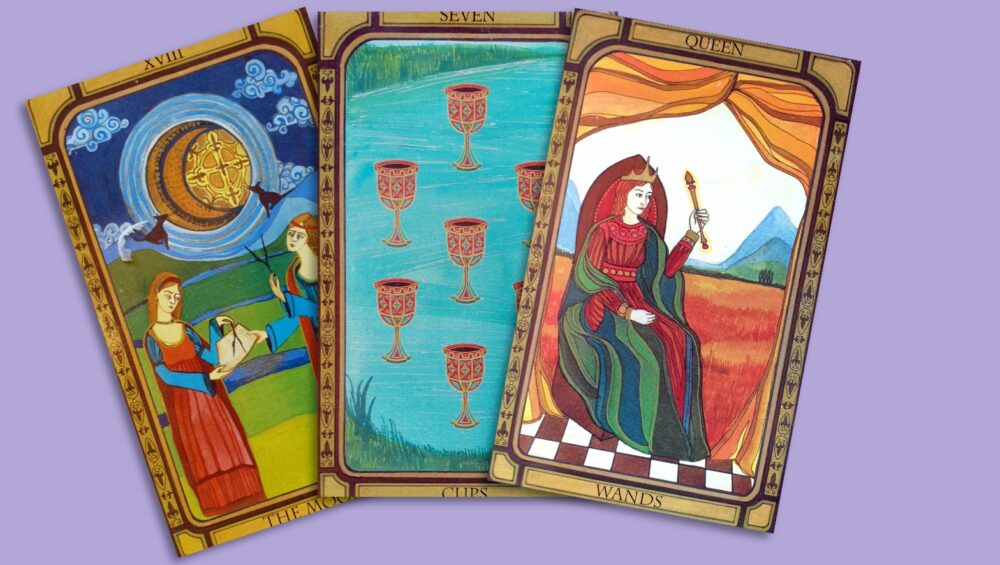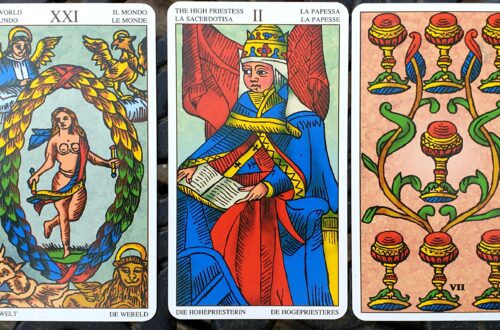
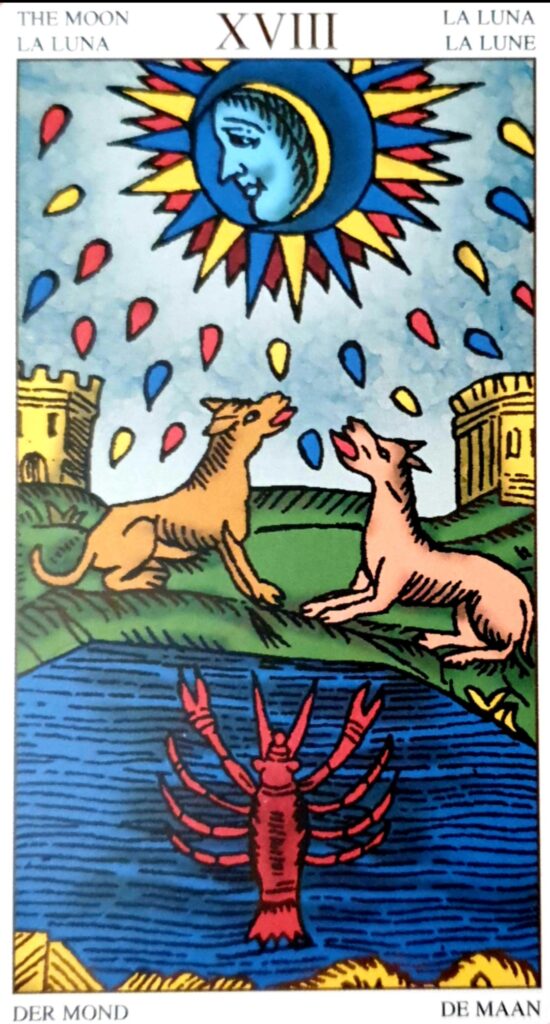
An ancient card, as old as the Universe. Dogs howl at a mystical evocation of a human profile, emanating moonbeams. A crayfish climbs from the water, drawn by the light. Two medieval towers, or lodges, form a portal.
This is the great mystery. Science might claim to know the Moon, but it cannot. We can only know it from its light, or from its cycles. It waxes, it wanes, it rises, it falls.
Moonlight is no light, it is a reflection of the hidden Sun. We live by sunlight, it nourishes and warms us, it feeds our crops. The Sun guides us, it marks our seasons.
Moonlight deceives us, it denies us colour. The Moon’s energy moves our tides, and moves our own essence, heightening our senses, unsettling us.
The night keeps death close. For all our electric light, we cannot pretend that the day is infinite, that the Sun in which we work, play and love is not doomed to leave us. Even the Moon is mortal, over and again we watch it grow, flourish and then slip once more into darkness.
The coming and going of the light reminds us that our own lights will one day be snuffed out. Death turns our bodies cold and still. They wither quickly, the skin tightening about the bones.
We form so much of our knowledge from what we see, yet what we see is elusive. The crenellations of a tower are one thing by day, quite another by night.
All our knowledge must be confounded, save for one certainty: that we will die. In the end, all our glorious learning and discovery is as fleeting and deceptive as the moonlight.
It is a great liberation. We are born free and we die free. The noise and fuss that tugs at us has no meaning. We can absorb ourselves in it, or ignore it. We can live the life we choose, at least within ourselves. Others will impose rules and beliefs, all born of their terror of the night, of darkness, of Death.
These are the true Fools. The ones who think there is any meaning other than Death. Whatever ambition or ideal calls to us is only a denial of our mortality. We might remember Shakespeare, or Gandhi, or Genghis Khan, but they are dead, just as we will be. We might choose to celebrate and honour them, but we are still only searching for meaning where none lies. We are astonished by the breadth of Genghis Khan’s empire, but we can ignore it as if it never existed.
Life is moonlight. Fleeting, deceptive, beautiful. And, like the cycles and seasons of the Moon, it is enough.